
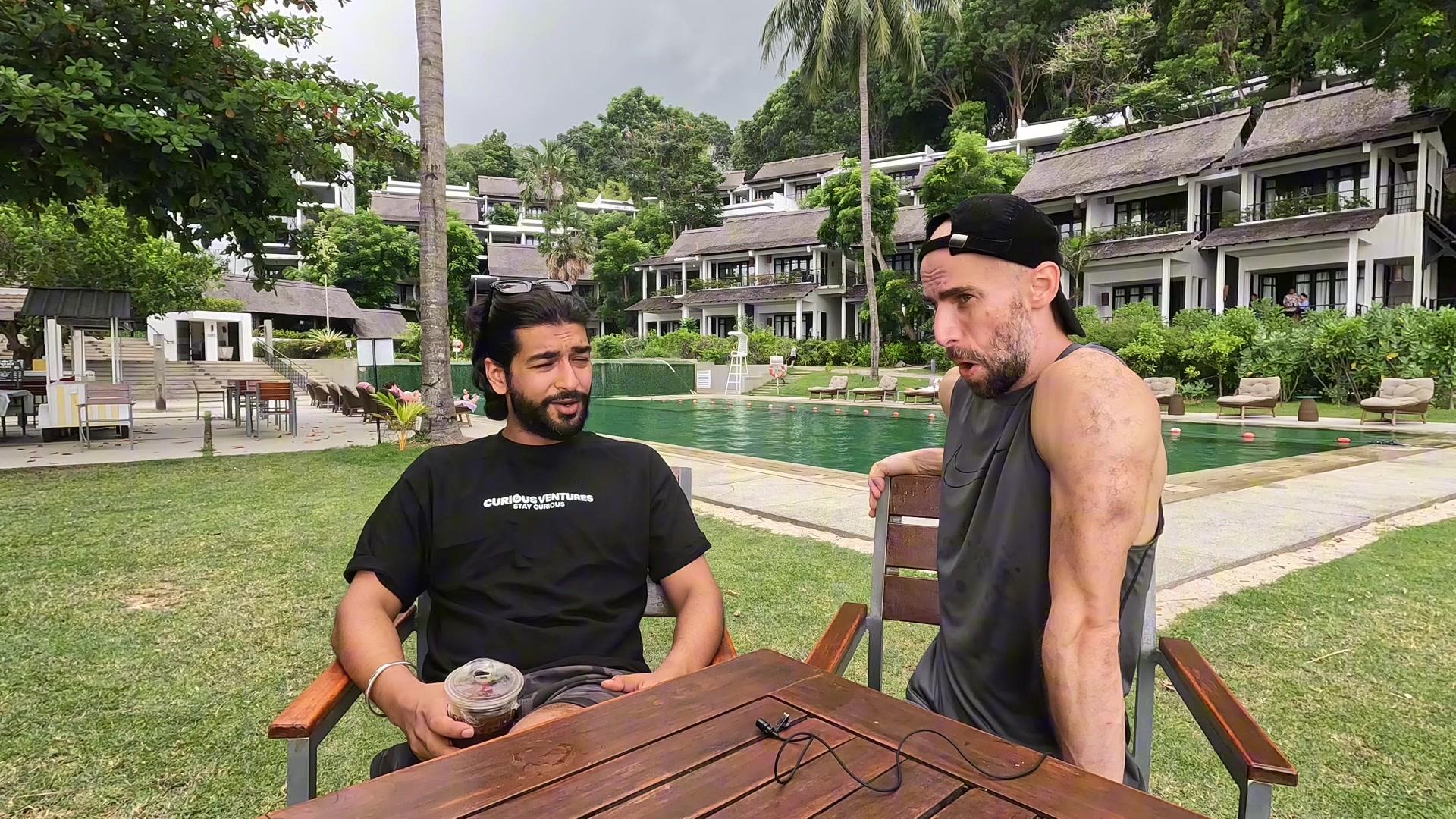
Some founders describe their careers as a straight line. Ashish Sood describes his as a series of things he got curious about, built, scaled, and then handed off. When we sat down at Network School in Bataan, with the rain starting up over the open-air hut we ended up moving into, he walked me through four companies in about ninety seconds, then spent the next hour on what he actually learned along the way.
This is the twentieth Argo Podcast conversation, and it sits squarely at the intersection the show keeps returning to: how someone builds, and who they become in the process.
A fund that follows network states
Ashish now runs Curious Ventures, a fund with an unusual mandate. It has no fixed geography. Instead of a home city, it follows network states, the pop-up communities of builders that gather in places like Network School, Edge City, and Bali. His pitch to himself was simple: there is real talent in these rooms, and much of it has never scaled anything. He has, several times, so he can be useful.
The word on his shirt, and tattooed on his arm, is curious. It is not decoration. He describes himself, without much irony, as the best consumer in the world. He has spent well over ten thousand hours online across apps, games, social media, crypto, and hardware, and he treats that omnivorous consumption as a professional edge rather than a distraction. For a self-described generalist who once worried he had never given anything ten thousand hours, it is a neat reframe: maybe the ten thousand hours went into pattern-matching across everything at once.
Four companies before the fund
The résumé is worth slowing down for. His first company, Bar Uncle, was a nightlife app he started around age nineteen in Delhi, partly because he could not get into the good clubs and figured a business might be his way in. You could buy a bottle of alcohol virtually, and the price of that bottle would shift depending on which of the 190 onboarded clubs you carried it to. He ran it for three and a half years, raised about fifty thousand dollars from friends, family, and fools, and eventually sold it when he realized he was selling an experience in a market that wanted discounts.
Then came PaySense, where he joined a small team doing short-term personal loans in India and helped scale it toward hundreds of people before it was acquired by PayU. He is candid about the machinery of lending, including the recovery buckets that decide how gently or harshly a late borrower is treated, and a more inventive idea: underwriting people by their social nodes, on the theory that if five friends repay on time, you probably will too.
During COVID he ran Let's Binge, aggregating small homegrown food brands into a shared dark-store and shelf-space model that cut their costs. He shut it down when a tokenization project he was building on the side, Polytrade, took off. Polytrade started with invoice factoring and grew into what he calls an Amazon for real-world-asset tokenization. He ran it for three years before stepping away.
Living where founders live
The most interesting part of the conversation was about how he now decides whom to back. Having raised money seven times himself, he knows the game from the other side. He calls it founder fraud, and includes himself in the indictment: a founder can learn exactly what an investor wants to hear, and AI makes that easier than ever.
You can hold a facade for a call, or twenty calls. You cannot hold it for fifteen days while someone watches how you actually work.
His answer is not a better set of questions. It is proximity. He moves into the same places founders live, so he sees them at 2AM and at noon and at 5PM, not just across three polished calls. You can perform for a call, he says, but you cannot perform for fifteen days while someone watches whether you are loving the problem or just performing it.
His first check out of Curious Ventures went to Nacho and Sam, whose AI content company is becoming Amplify AI, and he framed the money the way he frames all of it: money is only a multiplier. Give money to a chaotic team and you get more chaos. Give it to people who know what they are doing and it becomes leverage.
Calm down on building
For a room full of people shipping apps in fifteen days, his advice this month has been almost contrarian: calm down on building. Falling in love with a solution is easy, especially when generating tokens gives you a small hit of godlike feeling. Falling in love with a problem is harder and more useful. Spend eight hours actually thinking before you spend thirty days building. When you pitch, talk only about the problem, and aim for the listener to see your solution on their own by the three-minute mark. If they get there before you say it, they will believe it more.
He sold it before he built it
The story he had not told in a decade was about that first app. He had no money and no idea how to make a prototype, so he bought a pack of black A4 sheets, sat in his room with pens and pencils, and drew the entire app by hand, every view and user flow, over two days. He took the stack to an agency, offered twenty percent of the company for a corner of their office and two engineers, and walked out with a team building it for free. “I sold the product before I built it,” he said, “and I did not spend a penny.” It is a good reminder that the constraint that looks like a wall is often just a prompt to be resourceful.
We closed on quieter ground. He keeps a rule: if he spends a hundred days wanting to change something, he changes it. He reads with the audiobook playing in his ears and the physical book open at the same time, a workaround for an attention span he says most of us now share. And his prayer, a Hindu one, comes down to a single instruction he tries to live by: be pure to yourself. Know what you are doing. Keep your conscience clear enough to sleep.
Key takeaways
- Treat broad consumption as a skill. Ashish’s edge is having genuinely used almost everything, which lets him pattern-match products fast.
- Proximity beats interrogation. Living alongside founders reveals in fifteen days what no set of calls can.
- Money is a multiplier, not a fix. It amplifies whatever state a team is already in.
- Fall in love with the problem. Give thinking its hours before building takes over.
- Resourcefulness can replace capital. A hand-drawn prototype was enough to get a product built for equity.
Links & mentions
- Curious Ventures, Ashish's fund following network states
- house.curiousventures.xyz, his private tracker of founders he has met in person
- Ashish Sood on X, @soodgen
- Amplify AI, AI content startup (founders Nacho and Sam), Curious Ventures’ first investment
- Courage to be Disliked, book by Ichiro Kishimi and Fumitake Koga