
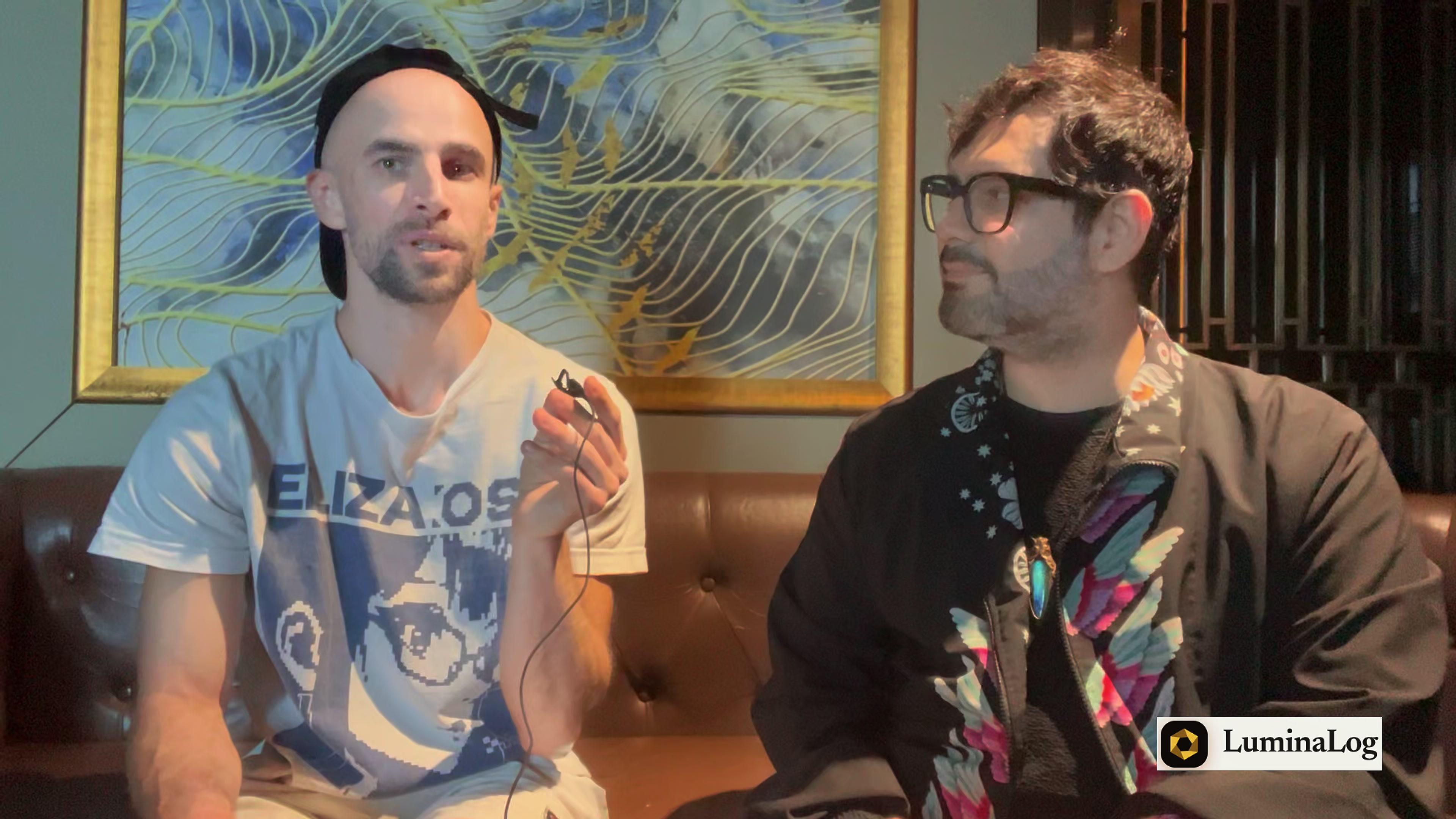
Some conversations start with a handshake. This one started with six breaths.
I sat down with Koss, a builder I met at Network School, though we'd apparently crossed paths somewhere before that, for one of an ongoing series of chats with people in technology doing interesting things. Koss goes by a pseudonym (his real last name, he says, is “very long”), grew up between Venezuela and Europe, and has spent the better part of a decade in and around Ethereum. What made the conversation worth publishing wasn't the crypto résumé, though. It was where his curiosity is pointed now.
It starts with six breaths
Before any of the “so, who are you” questions, we took six slow breaths together, a small ritual to reset the nervous system and actually arrive in the room. Koss's take: you can get good at anything if you practice it, and breathing is no exception. “That skill is your mind–body connection.” It's a fitting way to open a conversation that keeps circling back to the same question, how do we pay better attention to what's actually happening, in ourselves and around us?
From hyperinflation to Ethereum
Koss's route into crypto was, in his words, “kind of easy.” Growing up in a country living through hyperinflation, thousands, then hundreds of thousands, then millions of percent, makes the question what could sound money mean for a financial system? feel less theoretical. Bitcoin, arriving around 2009–2010, was the first crack of light. But he couldn't stop at money.
When the DAO came around, Ethereum felt closer to what he actually cared about: not just financial applications, but governance. That pulled him into years of work in decentralized governance, on-chain mutual credit, managing commons goods on-chain in the spirit of Elinor Ostrom's work, community after community. His day job now is in decentralized storage, but the through-line has always been the same: we need new systems, and the interesting part is how you govern them.
Community as an excuse to connect
Koss has been organizing communities “since forever” Ethereum Venezuela, civic-innovation groups, a Singularity University chapter, meetups that ran from roughly 2015 until the pandemic. His framing of why is the most useful thing anyone's said to me about events in a while. An organized gathering, he says, is really just a good excuse: to read the things you were already going to read, to meet people chasing similar questions, to flesh out your own half-formed ideas out loud, and (crucially) to talk to people you admire.
Reach out to your heroes. It's courageous, and most people shy away from it. That's exactly why it works.
The payoff compounds. He described an early online Venezuela event featuring one of the founders of Axie Infinity, who then turned up at Network School years later. “Connections compound over time.”
A social network built on biology
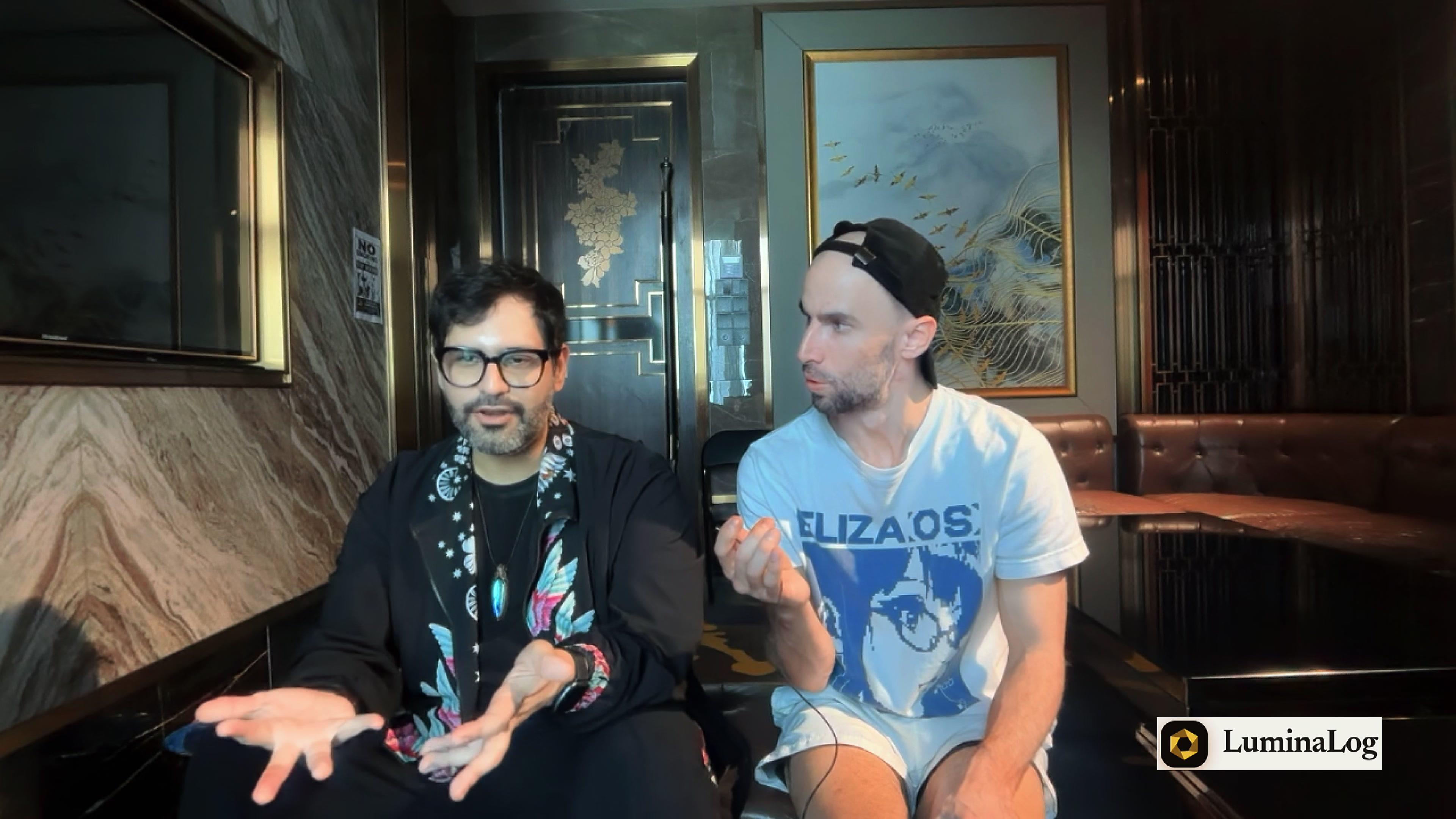
Here's where the conversation tipped into the frontier stuff. Koss held a role at IoTeX, working with data streaming off IoT devices, and came away “underwhelmed” by how little we do with those streams. That dissatisfaction has since branched into two obsessions.
The first sounds like science fiction until you sit with it: a social network based not on how people perform online, but on how they actually feel in each other's presence. Telegram and WhatsApp connect us by text; what would it mean to connect people by biology, by the real, embodied signal of being in a room together?
He's clear-eyed about the hard part. A biomarker on its own is close to meaningless. Someone with an elevated heart rate could be stressed, or thrilled, or both at once: “I want to go to a metal concert; my body is getting all this stress signal, but at the same time I'm in bliss.” Context, he estimates, is 75% of correctly interpreting any single reading. You need more than one data point, across time, plus the environment around it. This isn't a gadget problem; it's a sense-making problem.
Reading the signals of life
The second obsession scales the same idea up from a person to a planet. Koss is drawn to interspecies research (the work of translating, say, the vocalizations of whales) and more broadly to the signals streaming off all of life: plants, animals, geology, even tectonic movement. What if that signal fed into the decisions we make?
He's especially interested in bioregions, the stretch from southern Mexico through Central America, for instance, where climates, crops, and weather patterns behave similarly across national borders. Capture that signal with open hardware and put it on-chain, and something quietly radical happens: an ecosystem can be shown to have measurable, economic value. And economic value, sadly, is a language companies and governments speak far more fluently than “the forest is nice, let's protect it.”
His model for doing this well is GainForest (the work of David and Charlie, whom he met through a Funding the Commons residency). A weather station in the woods isn't enough. GainForest triangulates: public satellite data (heavily filtered for clouds and noise), drones flying the canopy directly, and people on the ground: three independent ways of validating the same reality before anyone makes a decision from it.
The logic he keeps returning to is simple and powerful: once you can measure something, you can manage it. And once you have clean raw data, you can point today's models at it. For most of history we were bottlenecked by single experts, thirty years to grow a PhD, a handful of good thinking-hours a day. Now you can throw state-of-the-art models at the data and surface patterns no one person could ever hold in their head, not to extract from a system, but to figure out how to coexist with it.
DevCon, and the “global majority”
The back half turned to community organizing at scale. Koss has been a fixture at DevCon (Bogotá, Bangkok) and DevConnect (Amsterdam, Buenos Aires), and is deep in planning for DevCon Mumbai later in 2026. His goal is to make it cosmo-local, following Michel Bauwens's language and the “Ethereum localism” work coming out of Portland and Denver, so a global event genuinely plugs into the place that hosts it. His own affiliations run through web3privacy now and the Cypherpunk Congress, and he's helping plan a week-long Network School activation ahead of the conference.
One reframe stuck with me: the shift some crypto communities are making from talking about the “global south” to the “global majority”, a subtle but real change from market to be captured toward bloc that aligns for itself, as regions in Southeast Asia, Africa, and Latin America build stronger ties with one another.
Inventing the future
We wound down where these conversations often do, on the tension between roots and acceleration. Both of us grew up far from the center of things (Venezuela; Eastern Europe), and we share the sense of standing between two pulls: the deep connection to ancestors and centuries of human continuity on one side, and technology remaking the world every single day on the other. Industrial, electrical, computer, and now AI revolutions each force the same question: how do we want to live, together, and what do we actually value?
Koss's answer, borrowing Alan Kay, is the note to end on: the best way to predict the future is to invent it. (And the name? “Koss” is short for Cosmo, itself short for cosmostasis, a play on homeostasis, balance held not just in a body but on a cosmic scale.)
Key takeaways
- Lived experience of hyperinflation makes the case for sound money and better systems viscerally, not abstractly.
- Organizing a community is really an excuse to learn in public, meet your heroes, and let connections compound.
- A biomarker without context is noise; interpretation (time, environment, meaning) is most of the work.
- Measuring living systems (bodies, forests, bioregions) is what lets us value, manage, and protect them.
- Triangulate your data (satellite + drones + people on the ground) before you make decisions from it.
- Point AI at clean raw data to find patterns no single expert could, in order to coexist, not just extract.