
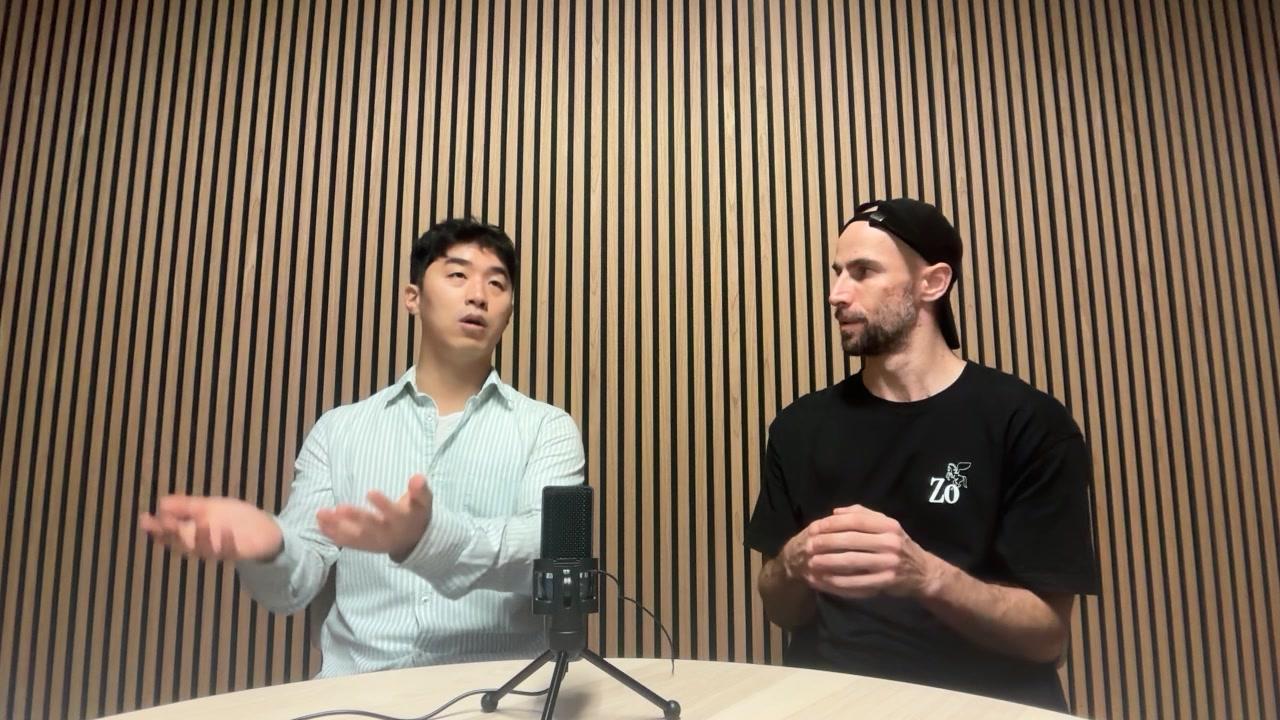
Some founder stories are a straight line. Daniel Jiwoong Im's is not. When I sat down with him at Network School for this episode of the Argo podcast, the phrase he kept returning to was that almost nothing in his life was planned. And yet the path, from a deep-learning lab, through crypto market data, to a social app about opinions: has a logic to it that only becomes visible when you lay the pieces side by side.
Taught by the godfather of AI
Daniel studied computer science and mathematics at the University of Toronto, and he happened to be there at an extraordinary moment. He learned machine learning directly from Geoffrey Hinton, the researcher often called the godfather of AI and, more recently, a Nobel laureate in physics. His teaching assistants at the time included Ilya Sutskever and Andrej Karpathy, names that would go on to define the field.
What hooked him wasn't the math so much as the way Hinton explained it. He described following Hinton to his office hours day after day, then going back to read his papers from the 1980s, including work that analyzed the weights of a neural network to reason about what “brain damage” might look like inside it. The lesson underneath the story is a quietly useful one: sometimes a whole career turns on a single teacher who makes an idea feel alive.
From Toronto he did a master's at Guelph, worked on generative models at MILA in Montreal in Yoshua Bengio's orbit, and then took a turn into neuroscience at the Janelia Research Campus (part of the Howard Hughes Medical Institute). There he built AI models of fruit flies, not physically, but simulating how flies of different genotypes move and socially interact, so that a group of simulated flies would reproduce the behavior of the real ones.
Why he left research to build
After Janelia came a PhD at NYU focused on causal inference, the study of telling causation apart from correlation. He gives a clean example in the episode: heat a cup of coffee and a thermometer rises, but a rising thermometer doesn't make coffee hot. In data, the two look identical; the whole discipline is about recovering the direction of the arrow. It's the kind of thinking that shows up later in how he reads markets and products.
He spent four and a half years on that PhD and then left. Part of the reasoning was refreshingly practical: if he finished the doctorate, he'd be around thirty, likely with more commitments, and a worse position from which to take startup risk. Better, he decided, to try when he had nothing tying him down. His first company, AIFounded, was an AI search engine, built on the intuition that models, like people, need a way to retrieve information beyond what they already “know.” An acquisition by Element AI fell through in a way he describes vividly (the deal talks alone were enough to drain the team), but the search IP was ultimately sold to Clearview AI. A small first exit, and a big first lesson.
Into crypto, and the wisdom of markets
Crypto found him through people. A former colleague, Ethan Buchman, went from machine-learning research to co-founding Cosmos and Tendermint, and Toronto and nearby Waterloo were a hotbed as Ethereum was taking shape. During the 2017 ICO era he joined Coinscious, a startup mining millisecond-level market data across roughly nineteen exchanges. One of its most interesting jobs: statistically inferring how much of an exchange's reported volume was fake wash trading, analysis that helped the hedge fund 3iQ meet compliance requirements for the first Bitcoin ETF.
When COVID and “DeFi summer” hit, he built his own automated market maker (AMM) and pointed it at sports betting, launching UBet. But after three years he'd absorbed two lessons that reshaped everything: don't improve something that already exists (he prefers “all or nothing” bets where you create a new category and quickly learn whether it works), and don't build only for the small web3 audience: go where the consumers are.
A TikTok for opinions
That's the path that led to Belief Market. He describes it as “a TikTok for opinions” a social app where anyone can create a market on a claim (“Donald Trump is an alien,” say), pick a side, argue, and stake money that pays out to the winning side when the market closes. Crucially, he insists it's not a prediction market. It isn't about forecasting the world; it's about participation, tribes, and internet drama, food rivalries, anime-character showdowns, a community member posting her paintings for feedback. He's even weighing a rebrand, because the word “market” makes people expect Polymarket-style prediction when the real DNA is closer to social media for Gen Z.
The most honest stretch of the conversation is about motivation. Belief Market rewards new users with cash to get them in the door, but Daniel knows money can crowd out intrinsic fun, and cites the classic study where kids who loved drawing drew less once a reward was introduced and then removed. The real retention, he thinks, has to come from something intangible: identity, the way your Instagram feed becomes a kind of public autobiography. Right now his single north-star metric isn't user growth but retention rate.
Think about what to execute
Near the end, alongside some grounded advice about work-life balance (“it's a marathon, not a sprint; be kind to all parts of yourself”), he offered the line I keep thinking about. It's easy, he said, to just run: to execute so hard and so busily that you look up and realize you haven't gone far, because you never stopped to think about what to execute. His fix is almost algorithmic: a greedy approach that solves the single most important priority rather than juggling many at once.
And then he closed the loop on his whole story. The connective tissue between machine learning and Belief Market, he said, is the wisdom of crowds. In ML, a mixture of experts beats any single model; in life, prediction markets and trading rest on the same premise: the aggregate is smarter than the individual. Money is just a reward function, and the market, in the end, is what chooses you. It's a fitting thesis for a founder whose own path looks random up close and coherent from a distance.
Key takeaways
- A single great teacher can set a trajectory. Hinton's classes, not the math itself, pulled Daniel into AI for good.
- He optimizes for “all or nothing” bets, new categories where you quickly learn whether the thing works, over incremental improvements.
- Rewards are double-edged. Cash gets users in the door, but durable retention comes from identity and intrinsic fun, not payouts.
- Think before you execute. Busyness isn't progress; a greedy focus on the single most important priority beats multitasking.
- The wisdom of crowds is his through-line, from mixture-of-experts models to prediction markets, the aggregate beats the individual.
Links & mentions
- Belief Market, Daniel's current company, a social opinion app
- MisoCare, his healthcare venture
- UBet Sports, his earlier on-chain sports prediction market
- AIFounded, his first company, an AI search engine (IP sold to Clearview AI)
- Coinscious, crypto market-data startup that worked with 3iQ
- Cosmos / Tendermint, blockchain project by his former colleague Ethan Buchman
- Geoffrey Hinton, Ilya Sutskever, Andrej Karpathy, Alex Graves: University of Toronto AI figures
- Yoshua Bengio (MILA), Yann LeCun: deep-learning pioneers mentioned
- Janelia Research Campus, where he did ML for neuroscience
- Polymarket, Augur, Kalshi, prediction markets discussed
- Network School, where this conversation was recorded
- Daniel on X, Instagram, and LinkedIn