
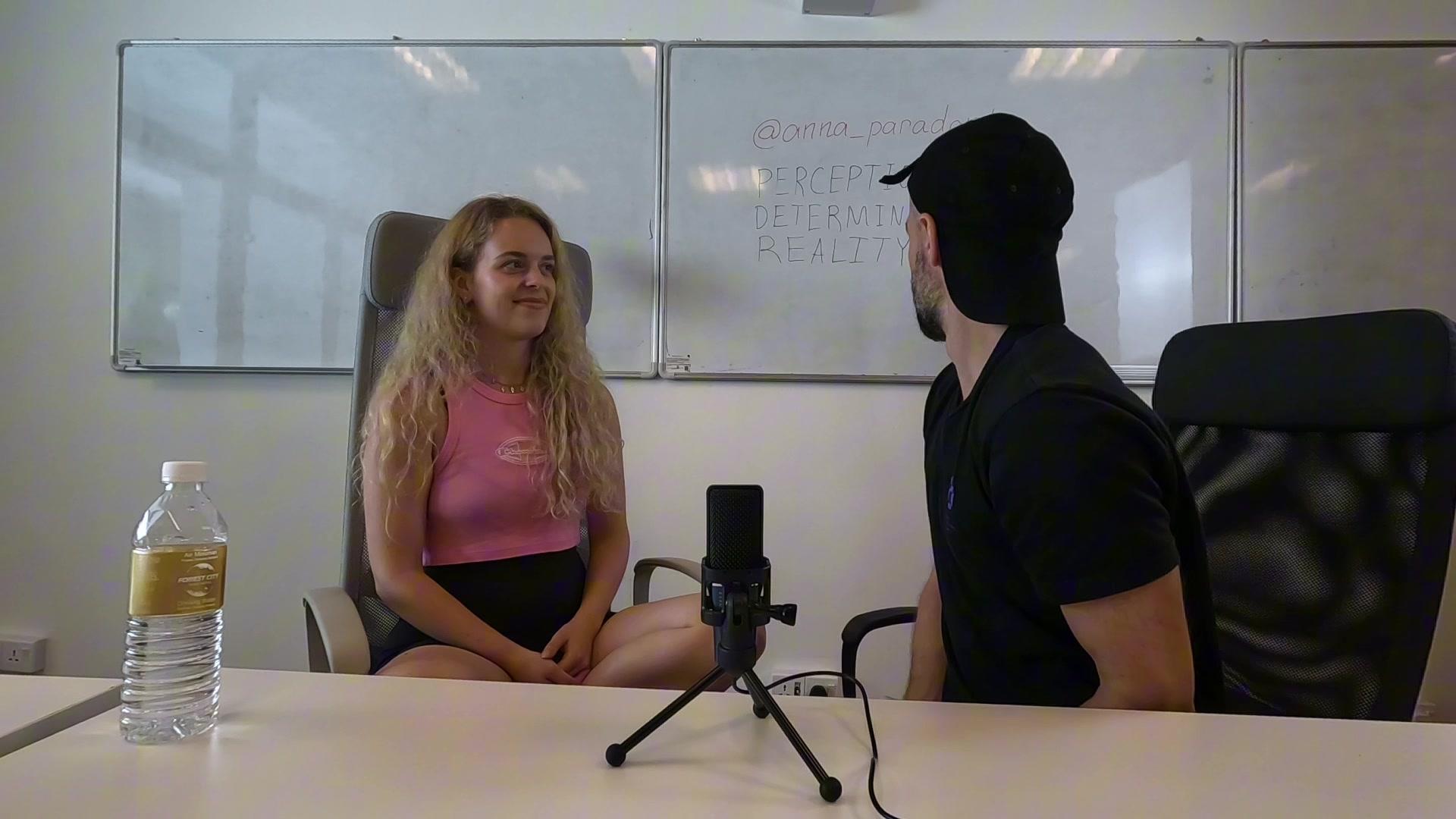
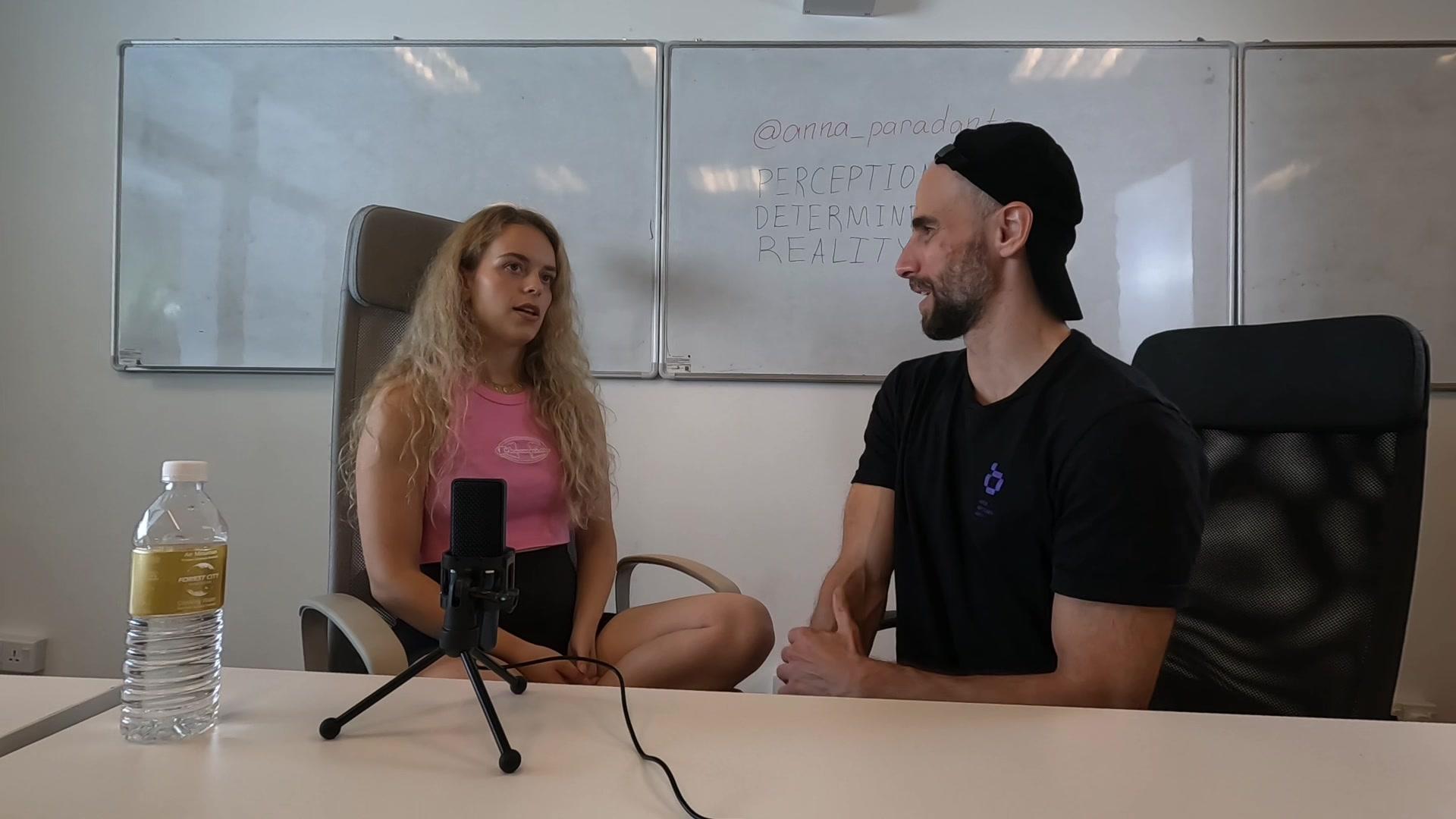
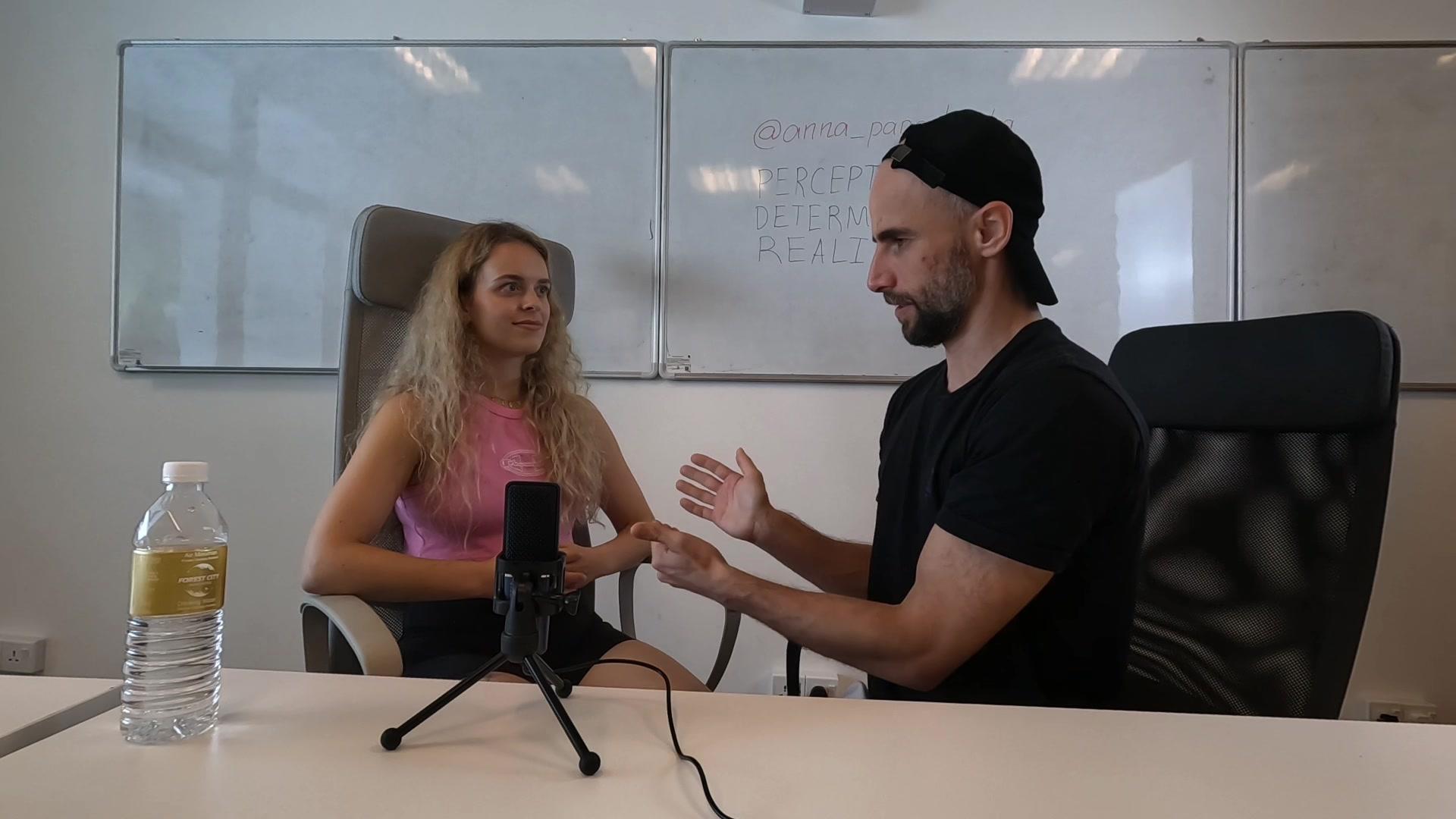
I met Anna Sokol in early July at Network School in Malaysia. We connected over yoga and long conversations about meditation and community, so it felt natural to sit down and record one. Anna is a meditation and awareness instructor and retreat facilitator.
Her life has an unusual arc. She grew up between Gorlovka and Kiev, moved to Australia at sixteen when her mother remarried, and then gave much of her twenties to a meditation community called Giving School, living and running retreats across Latvia and other countries. This conversation is about that arc, and what she took from it that the rest of us can use.
Perception, and the one tool we have
When I handed Anna the whiteboard and asked her to write anything she liked, she wrote “Perception determines reality.” It turned out to be the thread of the whole hour. Her framing is simple and practical: attention is the one tool we really have, and wherever attention goes, that is where our power goes.
She told a small, concrete story to make the point. Working an early job in Australia selling activewear, she started noticing every single person wearing that brand's leggings, everywhere, because it was already in her head. From there she made the obvious but easy-to-forget leap: if I can be primed to see leggings, I can learn to guide attention on purpose, toward what I actually want, and away from the fears and blockages that clutter the path. She is careful to say this was not a trick she read about but something she noticed in herself and then trained.
The mother, the change, and the first retreat
What actually pulled Anna toward this work was not an idea but a person. Her mother found the school first, and Anna, in her own words, assumed she had joined a cult and told her to keep her ideas to herself. Then she watched her mother change. One night Anna snapped at her, the kind of exchange that used to trigger a harsh response, and instead her mother stayed calm and kind. Anna says she looked at her mother's eyes and felt, immediately, that her mother had found something real, and that she wanted it too.
That led to her first retreat: fourteen days in Latvia, in minus twenty, with partial fasting and practices held outdoors. She describes walking and praying after a fasting day, an intensity of inner work she had never done, and coming out of it with what she calls huge openings. It is worth noting how physical her spirituality is. The cold, the fasting, the body: these are not incidental to the practice, they are part of it.
What makes a community last
This is the part I keep thinking about. I am drawn to communities, network states, and organizations that hold people together, so I asked Anna directly what makes a community last. Her answer had three parts, and none of them were about infrastructure.
First, a shared goal that everyone has consciously chosen and believes in with their whole heart. Without that, she says, a community cannot hold through hard times. Second, ongoing education of the people in it, learning how to build connections and handle conflict, because when groups pour everything into building infrastructure and skip the inner work, ego eventually shows up and someone wants a bigger piece. Third, everyone treating the shared project as if it were their own, as if they had created it.
She named those alongside the school's three stated values: live to your full potential, treat the people around you as your continuation, and pass on whatever you learn rather than hoarding it. A community, in her telling, is not built out of infrastructure first. It is built out of the people, and the work they do on themselves.
Fear mostly lives in the head
Anna's teachers, she says, deliberately push people out of their comfort zone. Again and again she was told the next course starts in two weeks, on another continent, and asked how she would arrange her life to get there. Each time the fears were the same: not enough money, work in Australia, no way to explain another absence. And each time she stepped through them anyway. Once she came back to find public holidays waiting, better pay, extra shifts, and no problem taking the leave. Her conclusion is understated: the scariest thing was simply choosing to step into the unknown, and the fears turned out to live mostly in her head.
Knowledge sits in the head. Wisdom is something you practice. If you do not do it, it is not wisdom yet.
Intention, impact, and the work you can only do with others
Later we got into the gap between intention and impact. Anna's view is that when the impact is bad, the intention was often quietly coming from what she calls a victim position, wanting something in return. She used the old line about giving a fishing rod instead of a fish, and added a second layer: sometimes a good deed carries a hidden condition, now you owe me, now you will respect me.
Becoming aware of those subconscious layers, she says, takes two things. One is regular practice, meditation that trains you to notice a reaction before you fall into it, what she calls a bigger depth of presence. The other is conscious interaction with other people who are doing the same work, in a space safe enough to see your own ego and step past it without it turning into ego-poking. It reminded me of the early Apple teams, brilliant people clashing, and how Steve Jobs later credited meditation with making him a better manager.
Carrying it into an ordinary life
What struck me most is how ordinary Anna wants all of this to be. She is not arguing for escaping into retreats forever. The real spirituality, she says, is integration: bringing energy from the deep work back into ordinary, creative life and actually building things. Along the way she developed skills she once only dreamed of as a child who wanted to perform, hosting events, project management, design, marketing, running a channel, all in service of the same thing.
We compared notes on this, my own path through a coding school and Silicon Valley, the pull between a stable career and a creative, nomadic life, and landed in the same place: it is about people, and about using whatever talents you have to make something with a real impact. Her closing note is one I will keep: whatever pure impulse you have inside, even if it seems unprofitable or out of reach, give it a shot, do it for fun, and see what happens.
Key takeaways
- Attention is the one tool we have; you can learn to notice where it goes and guide it on purpose.
- A community lasts on three things: a whole-hearted shared goal, ongoing education of its people, and everyone treating the project as their own.
- Most fear lives in the head. The way through is choosing to step into the unknown, repeatedly.
- Knowledge sits in the head; wisdom is something you practice.
- When an intention lands badly, it often came from wanting something in return. Awareness of that comes from practice plus honest work alongside others.
- The goal is not to escape into retreats but to integrate the inner work into an ordinary, creative life.
Links & mentions
- Anna Sokol on Instagram, @anna_paradanta, where she shares about community and practice
- Giving School, the meditation school and community she works with
- Network School, where this was recorded, in Malaysia
- Lorna Jane, the Australian activewear brand from her attention story
- Psycho-Cybernetics by Maxwell Maltz, the book on self-image she references
- Jane Addams and Hull House, the Chicago settlement house Konrad brought up on social activism
- 42, the tuition-free coding school from Konrad’s own story