
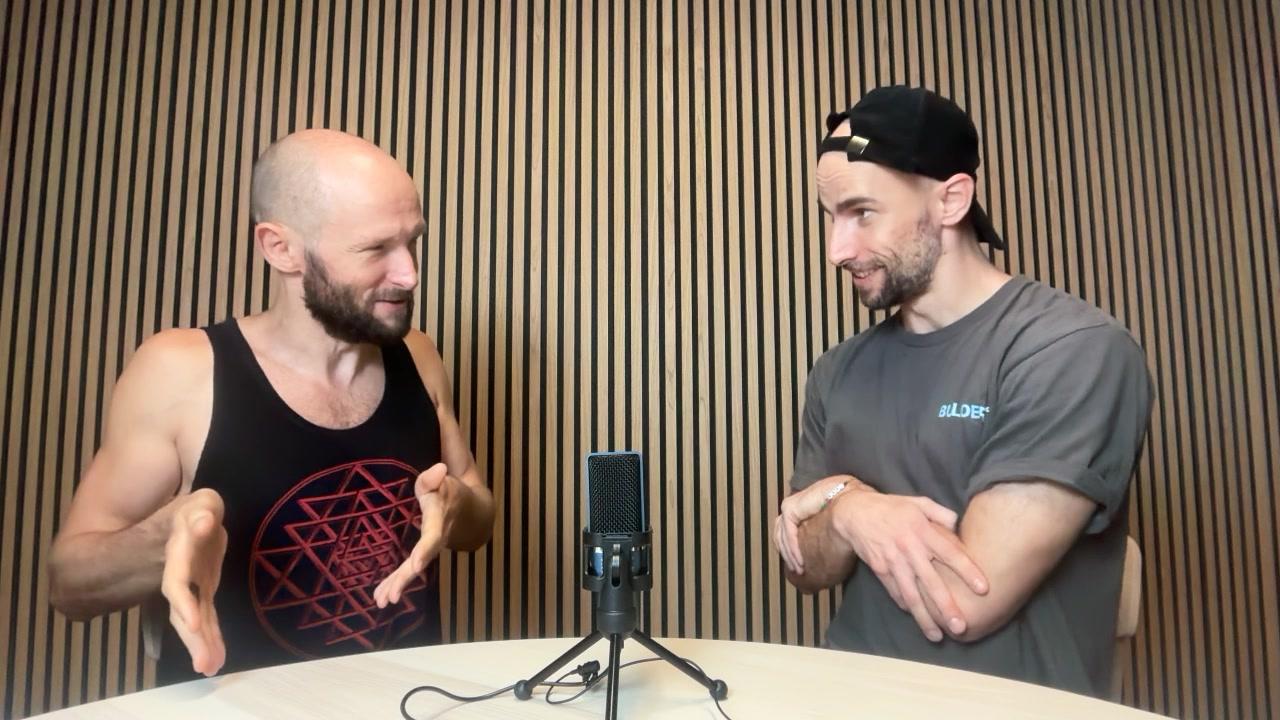
Some conversations start with small talk. This one started with Fourier. Chris Smith and I first met in the Network School café months ago, and within minutes we were thirty deep into a French mathematician who was laughed out of academia for suggesting you could decompose any wave into its constituent frequencies, the same math that now underpins every piece of audio and video you touch. It was the perfect opening for a guest who moves fluidly between the technical and the human: Chris, known online as UV Lightman, is a founder, a musician, a comedian, and someone building a blockchain to survive a threat most people haven't started worrying about yet.
The threat is an efficient attack
Quantus exists because of a tip. Chris and his co-founder Joe heard that quantum computing was advancing faster than the public was being told, and if you know where to look, that's an alarming sentence. Modern cryptography rests on problems that are easy to state and astronomically hard to reverse: factoring large numbers (RSA), and elliptic-curve math. Shor's algorithm collapses both.
The framing Chris uses is the one worth keeping: the danger isn't that an attack exists, every algorithm has known attacks. The danger is that an efficient attack exists. A well-designed system assumes even the world's biggest supercomputer would need thousands of years to break it. Shor's algorithm turns that from millennia into something tractable, provided someone builds the machine. Over a trillion dollars in Bitcoin currently sits on cryptography that a sufficiently capable quantum computer would peel open.
A “new Bitcoin” as a backstop
Quantus is a deliberate throwback. It's a proof-of-work chain focused entirely on the money use case, not a smart-contract platform. Chris built on Ethereum for years and respects it, but he's blunt that “the average quality of a smart contract is somewhere between malicious and completely broken.” So Quantus keeps the surface area small: 21 million coins, mined on your GPU, no ASICs, no KYC to acquire it.
The pitch is audacious, and he knows it. VCs have told him he's crazy, not only launching an L1, but positioning it against Bitcoin itself. His answer is that someone has to solve this, the timelines are compressing (the US government has already cut its own quantum estimates by more than half), and it might as well be a Bitcoin-Cash veteran who once wrote the bootloader decompression running on your Samsung TV. Quantus isn't trying to replace Bitcoin so much as stand behind it: a backstop, ready to catch the net if the thing everyone is trusting quietly breaks.
What money actually is
The most clarifying stretch of the conversation isn't about quantum at all. It's about money. When Chris first encountered Bitcoin in 2011, the hardest part wasn't the peer-to-peer networking or the proof of work, it was understanding why anyone would call it money. Digging in, he found that money has been “dramatically over-complicated.” At its core it's almost embarrassingly simple: if I do things for you, my number goes up; if you do things for me, my number goes down. Everything else (consensus, mining, the elaborate machinery) exists so a group of strangers can agree on that ledger without trusting a single point of failure.
There's an Argo lesson buried in there. The things we treat as impossibly complex often turn out to have a simple core we've buried under jargon. Naming that core, putting it into plain words, is most of the work.
A warning from a stranger
The origin story has a cinematic beat. At a Token 2049 side event, Chris demoed a Bluetooth peer-to-peer chat app he'd built, a geographic 4chan where you don't know who anyone is, but you know you've shared a room with them. Afterward a man approached, said he worked for NIST, the agency that effectively decides what cryptography the US government, and much of the world, uses, and told him quantum computers were further along than anyone was admitting, and that the public would not be warned.
Chris's reaction is the honest one: does this guy really work for NIST? If so, why is he telling me this? If not, why is he telling me this? You can't verify it. But it's the kind of signal that, combined with everything else, tips a person from thinking about a problem to building against it.
Local AI and the exocortex
When the conversation turned to Argo, the private, AI-assisted journaling practice this podcast is part of, Chris was thoughtfully cautious, and that's exactly why it's worth hearing. He's protective of his inner life; he doesn't want a model on his phone reporting his mind-state back to the network. But he lit up at theidea underneath it: AI as an exocortex. An external memory where the patterns that shape our lives (the ones that recur too infrequently to notice) could finally become visible. “Imagine someone who knows everything about you,” he said, “and can tell you: in the past few relationships, you had this pattern.”
His condition is sovereignty: run it locally, keep the key, don't trade self-knowledge for surveillance. That maps almost exactly onto why Argo is end-to-end encrypted. The tool should serve the human, not the other way around.
Both halves of the brain
We closed where Chris lives most comfortably, the seam between logic and intuition. “God gave us two hemispheres,” he said; treating yourself as a “left-brain person” or a “right-brain person” is a way of amputating half your capacity. Language, in his view, should be a set of toys you pick up, play with, and put down, never a master. He makes music as UV Lightman, writes a Substack calledweaponized schizophrenia about cybernetics and sense-making, and points out that the very conversation we were having was improvised: nobody rehearsed it, and it worked fine. The plan-everything-or-it-fails instinct, he argues, is a profound misunderstanding of how your own mind already works.
Key takeaways
- The real cryptographic risk is efficiency. Not that an attack exists, that an efficient one does. Shor's algorithm targets the RSA and elliptic-curve math securing most of the internet and over a trillion dollars in Bitcoin.
- Quantus is a narrow, quantum-secure backstop. A proof-of-work chain focused only on money, in case Bitcoin's cryptography fails.
- Money is simpler than we make it. A shared ledger of who did what for whom; the complexity exists to remove the trusted third party.
- AI's best use may be self-knowledge. An exocortex that surfaces your patterns, but only if it runs locally and keeps your sovereignty intact.
- Don't pick a hemisphere. Logic and intuition are tools that snap together, and most of what you do well, you already improvise.
Links & mentions: Quantus (mining at quantusminer.com), NEAR Protocol, ecdsa.fail, The Network State by Balaji Srinivasan, Boost VC / Draper University, Coinbase's Brian Armstrong, NIST, Token 2049, Buckminster Fuller, Norbert Wiener, Douglas Hofstadter's Gödel, Escher, Bach, and Steven Levy's Crypto. Find Chris as UV Lightman (search “yuvilightman”) on X, YouTube, SoundCloud, and Spotify, and his Substack at weaponizedschizophrenia.com.